The Medicine Buddha Sūtra: the story of a travelling text
A birch-bark manuscript, a pilgrim monk, a visiting translator: how a sūtra probably born in northern India or Central Asia became one of the most read texts of East Asia.
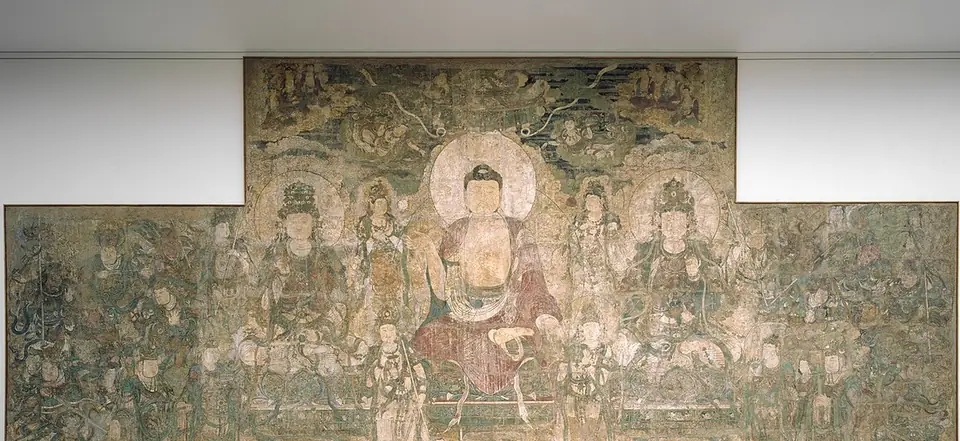
The text opens at Vaiśālī, a city of ancient India. The Buddha is staying there with a great assembly of monks, bodhisattvas, kings and beings from every world. The bodhisattva Mañjuśrī rises and asks him to speak of the qualities of another Buddha, far to the east, whose name will be a help in difficulty for beings of future generations. The Buddha agrees: this is the beginning of the Medicine Buddha Sūtra (Bhaiṣajyaguruvaiḍūryaprabharāja-sūtra). Here is how it unfolds, scene by scene.
What the sūtra tells
The text is short and follows a simple plan. First, the description of the Buddha of a distant land and of his twelve great vows. Then the description of his pure land, his bodhisattvas and the benefits the text ascribes to him. Finally, ritual prescriptions: how, according to the text, to venerate him, how to recite his name, which offerings to prepare. Near the end, Ānanda asks a bodhisattva named Deliverer (Jiutuo, in Xuanzang’s version) about the “nine untimely deaths” and what can be done to avoid them. The rites described (lamps lit, banners hung, offerings) are presented as ways of awakening kindness and wisdom, and of honouring the memory of the dead.
A manuscript found near Gilgit
In 1931, local people near Gilgit, in the Karakoram, came by chance upon a set of birch-bark manuscripts in a ruined stūpa. They are in Sanskrit, in a script called “Gilgit-Bamiyan”. Among them is the Medicine Buddha Sūtra. It was edited in 1939 by Nalinaksha Dutt in the series Gilgit Manuscripts, and it is the oldest known Sanskrit version. It is a lovely surprise: the text, which was known only through its translations, did exist in India or on its borders in this form.
The Chinese translations
In China the sūtra was translated several times. An early version, attributed to Śrīmitra, dates from the 4th century. Dharmagupta gave another in 615, under the Sui. The most famous is Xuanzang’s, in 650, by the monk who had crossed Central Asia and India to bring back texts; it is the basis of most recitations in China, Korea, Japan and Vietnam. In 707 Yijing, another travelling monk who returned from India by sea, offered a longer version describing not one but seven Medicine Buddhas. These translations are kept in the Chinese canon (Taishō 449[3] to 451; Śrīmitra’s early version is chapter 12 of the Consecration Sūtra, Taishō 1331[6]).
The text in Tibet
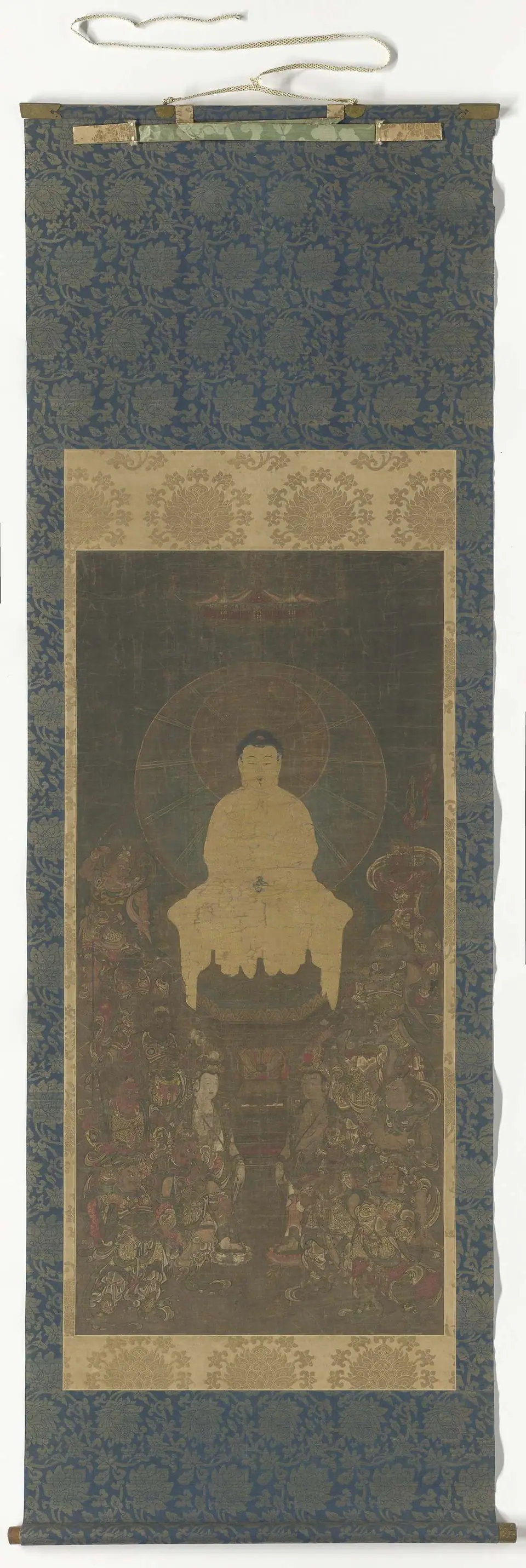
The text is also kept in the Tibetan Kangyur, where both the “single Buddha” version and the “seven Tathāgatas” version exist. The eight Medicine Buddhas, whose images decorate so many monasteries, come from this tradition.
Why it was so successful
In societies where illness, poverty and war were close to everyone, a Buddha whose vows promise help, food, clothing and justice spoke to all. In Japan, it was a prayer for an emperor’s wife that gave birth to Yakushi-ji in 680; the story is in the article on Yakushi-ji.
Reading the sūtra today
Translations exist in French and English, with commentaries; you will find them in the books section. A cursory reading takes less than an hour. The sūtra reads like a prayer, not a medical treatise: see the article on spiritual health.
The title and what it means
The full Sanskrit title, Ārya-bhagavato bhaiṣajyaguru-vaiḍūryaprabhasya pūrvapraṇidhāna-viśeṣa-vistara, can be rendered as “Detailed account of the former vows of the Blessed One, Master of Remedies, Lapis-Lazuli Light”. Xuanzang’s Chinese title says the same more briefly: 藥師琉璃光如來本願功德經, “Sūtra of the original vows and merits of the Tathāgata Master of Remedies, Lapis-Lazuli Light”. The key words are “original vows” (本願): the text first tells what a bodhisattva promised, then what the awakened Buddha can offer.
The story, step by step
In Xuanzang’s version, the scene is set in Vaiśālī (廣嚴城), “under the tree of musical sounds” (樂音樹下). The assembly includes eight thousand monks, thirty-six thousand bodhisattvas, kings, ministers, brahmins and non-human beings. Mañjuśrī asks the Buddha to describe the names and vows of the Buddhas, for the good of beings in times to come.
The Buddha then describes a world in the east, beyond as many Buddha-lands as there are grains of sand in ten Ganges rivers. This world is called “Pure Lapis” (淨琉璃). Its Buddha is Bhaiṣajyaguru. Next come the twelve great vows, set out in the article on the twelve vows, then the description of the pure land: a ground of lapis lazuli, paths lined with golden cords, and two leading bodhisattvas, Universal Radiance of the Sun (日光遍照) and Universal Radiance of the Moon (月光遍照).
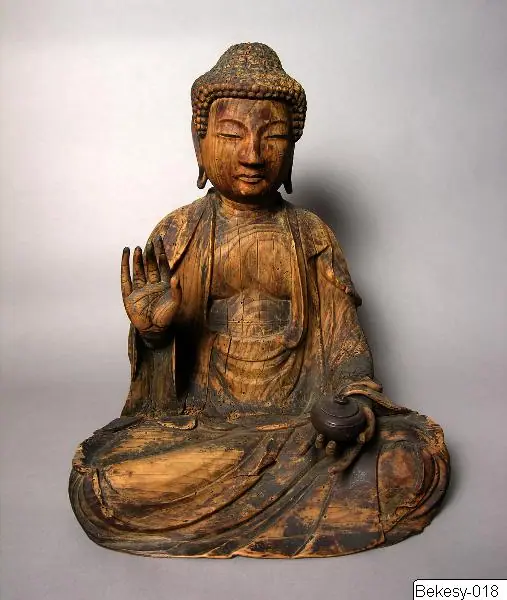
The central part lists what the text links to hearing and remembering this Buddha’s name: turning away from greed, keeping the precepts, leaving jealousy and quarrels behind. It also contains the passage of the great dhāraṇī: the Medicine Buddha enters a concentration called “removing the suffering of all beings”, a light shines from the crown of his head, and the formula is spoken within that light. The words of the mantra are explained in the article on the mantra.
The bodhisattva Deliverer and the forty-nine lamps
Towards the end, a bodhisattva named Deliverer (救脫) rises. He describes a sick person whose consciousness is led before King Yama, who judges deeds. For that person, the text says, the family may take refuge in the Medicine Buddha, have monks read the sūtra, light lamps on seven levels and hang five-coloured banners. The text then details a fuller rite: forty-nine readings of the sūtra and forty-nine lamps kept burning for forty-nine days. Ānanda then asks what the “nine untimely deaths” (九橫死) are. Among them: dying for lack of care, under the law, by wild beasts, by fire or water, by poison, by a fall, or from hunger and thirst.
These pages shaped much of the ritual around the Medicine Buddha in East Asia: lamps, banners, the release of animals, group recitation. They are religious rites, described here as the text presents them.
The twelve yaksha generals
The sūtra ends with a scene often shown in art. Twelve great yaksha generals in the assembly rise and make a vow: to protect those who keep the Medicine Buddha’s name and recite the sūtra. Each leads seven thousand yakshas. In Xuanzang’s version their names are Kumbhīra (宮毘羅), Vajra (伐折羅), Mihira (迷企羅), Aṇḍīra (安底羅), Anila (頞儞羅), Śaṇḍila (珊底羅), Indra (因達羅), Pajra (波夷羅), Mahoraga (摩虎羅), Kiṃnara (真達羅), Catura (招杜羅) and Vikarāla (毘羯羅). Other versions give slightly different forms. Their history in art is in the article on the twelve generals.
Five Chinese versions, and how they differ
- The version attributed to Śrīmitra (帛尸梨蜜多羅, 4th century): it forms chapter 12 of the Consecration Sūtra (灌頂經, Taishō 1331[6]). Several scholars think this compilation was made in China; another tradition attributes it to the monk Huijian (慧簡), around 457. The preface to Dharmagupta’s version already mentions a translation by Huijian, judged clumsy.
- Dharmagupta’s version (達摩笈多), 615, under the Sui: Taishō 449[3]. It does not contain the great dhāraṇī.
- Xuanzang’s version (玄奘), 650, under the Tang: Taishō 450[3]. This is the standard version in China, Korea, Japan and Vietnam. Current editions include the dhāraṇī.
- Yijing’s version (義淨), 707: Taishō 451[3], in two scrolls. It describes seven Medicine Buddhas, each with a land in the east and vows of his own, forty-four vows in all (eight, eight, four, four, four, four, then Bhaiṣajyaguru’s twelve). See the seven Buddhas.
The three classic versions (Taishō 449[3], 450, 451) follow the same plan. They differ in length, in proper names and in whether the dhāraṇī is present. The dates of the oldest versions come from tradition and catalogues; specialists still discuss them.
The Tibetan versions
The Tibetan Kangyur contains two related texts. The first, on the Medicine Buddha alone, is number 504 in the Tōhoku catalogue (Toh 504[7]). The second, on the seven Tathāgatas, is number 503 (Toh 503). Both have been translated into English by the 84000 project, and the translations can be read free online. In Tibetan practice these texts go with group rituals: the series of seven Buddhas, with Śākyamuni added, gives the “eight Medicine Buddhas” of the paintings. See the eight Buddhas.
Reading the original text online
- Xuanzang’s Chinese can be read free on CBETA (Taishō 450[3]), with the variants of the editions.
- Dharmagupta’s (Taishō 449[3]) and Yijing’s (Taishō 451) versions are in the same place.
- The English translation of the Tibetan version (Toh 504[7]) is published by 84000.
The exact links are in the sources below. For a first reading, start with the vows, then the scene of the bodhisattva Deliverer: together they give a good idea of the whole.
Sources
- Nalinaksha Dutt, Gilgit Manuscripts, vol. I (Srinagar, 1939)
- Raoul Birnbaum, The Healing Buddha (1979)
- Taishō Tripiṭaka 449–451 — T449 · T450 · T451
- Taishō 449 (Dharmagupta) — CBETA
- Taishō 451 (Yijing) — CBETA
- Taishō 1331 (Śrīmitra) — CBETA
- 84000, Toh 504
The dates of the oldest translations are attributions by tradition.
Lapis is free and has no advertising. You can support its upkeep.