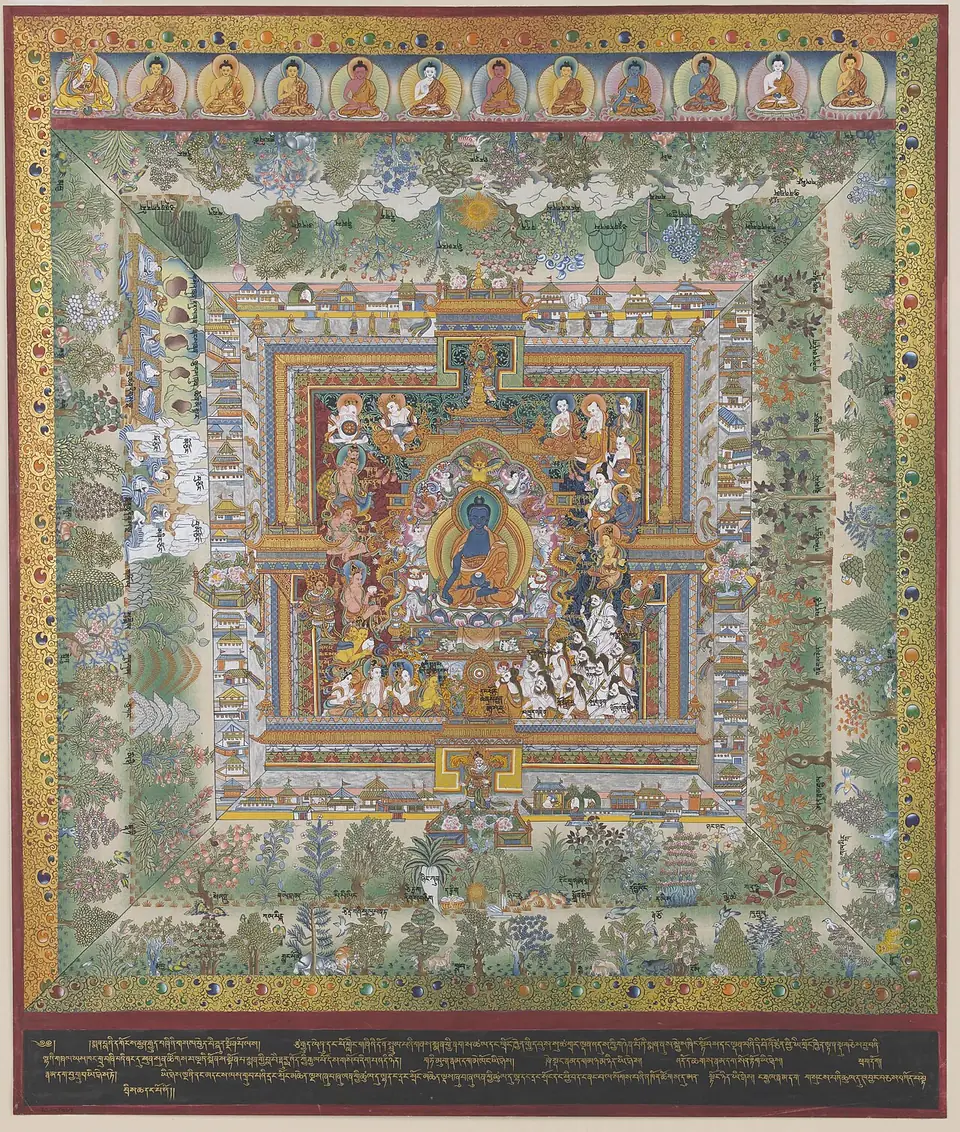
Medicine Buddha glossary: 31 words explained for beginners
Thirty-one words that come back in texts and images of the Medicine Buddha, each explained simply, with a small free image and a source.
In short
- 31 words in 7 themes, from the Buddha’s name to the objects seen in his images.
- Each word first shows a simple explanation; links, places and sources open with one click.
Glossary (31)
The name and the text (6)
- Bhaiṣajyaguru (the name)
Bhaiṣajyaguru · भैषज्यगुरु
This is the Sanskrit name of the Medicine Buddha, the “master of remedies”. Every other name (Chinese, Japanese, Tibetan) translates this one.
Go further
See also: Bhaiṣajyaguru, Bhaiṣajyarāja, Dhanvantari: not to be confused · Bhaiṣajyaguru, Menla, Yaoshi, Yakushi: the names by country
Where to see it: Brooklyn Museum
- Vaiḍūrya (lapis lazuli)
Vaiḍūrya · 琉璃 liúlí · བཻ་ཌཱུརྻ
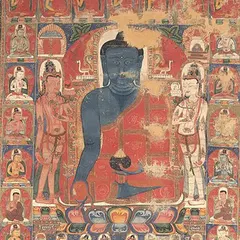
A precious blue stone named in the Medicine Buddha’s full title. Chinese renders it 琉璃 liúlí and most modern translations say “lapis lazuli”, though the exact mineral meant in old texts is debated (some propose beryl). This blue explains the colour of his body in Tibetan paintings.
Go further
See also: Lapis lazuli, the colour of the Medicine Buddha
Catalogue: Prayer beads (malas) and jewellery
- Tathāgata (Nyorai)
Tathāgata · 如来 · tathāgata
A title given to every buddha, often translated as “the one thus gone” or “thus come”. In Chinese it is 如来 rúlái, read Nyorai in Japanese: hence Yakushi Nyorai. Seeing the word tells you the figure is a buddha, not a bodhisattva.
- The sutra
Bhaiṣajyaguru-sūtra · 藥師經
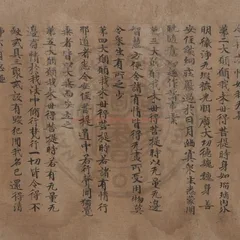
The Medicine Buddha is known above all from one text, the sutra of his previous vows. It survives in Sanskrit fragments, in several Chinese translations (616, 650, 707) and in Tibetan. It tells how, long ago, he made vows and describes his land in the east.
Go further
In the timeline: IV · V–VI · 616 · 650 · 1931
See also: The Medicine Buddha Sūtra: the story of a travelling text · Gilgit, 1931: the day the Sanskrit sūtra turned up · The story of the sūtra: Mañjuśrī, the Rescuer and the twelve generals
Where to see it: National Archives of India
Catalogue: Books and teachings
- The twelve vows
十二大願 · twelve great vows
In the sutra, before becoming a buddha, Bhaiṣajyaguru makes twelve great vows. They concern, among other things, making beings’ bodies radiant, relieving illness and poverty, and giving food and clothing. They are the core of the text; Lapis reports what the text says, as a religious text.
- The Pure Land of the East
Vaiḍūryanirbhāsā · 淨琉璃世界
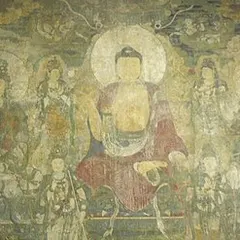
The sutra places the Medicine Buddha in a pure land to the east, called “Pure Lapis Lazuli” (淨琉璃世界). It is described as paved with lapis and gold. Mural paintings at Dunhuang depict it as a great palace above a lake, full of musicians and dancers.
Go further
In the timeline: 618–649 · 642 · 1107 · 1900 · 1987
See also: The Eastern pure land: Vaiḍūryanirbhāsa, the land of lapis lazuli light
Where to see it: 莫高窟 Mogao Caves
His retinue (4)
- Sunlight and Moonlight
Sūryaprabha · Candraprabha · 日光 · 月光
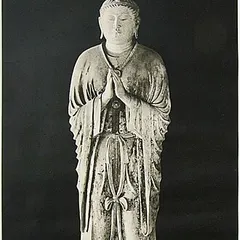
Two bodhisattvas, Sūryaprabha (“Sunlight”) and Candraprabha (“Moonlight”), are named in the sutra as his chief companions. With him they form a triad, very common in Japan (Nikkō and Gakkō). The statue shown here, at Tōdai-ji’s Hokke-dō, received the name Gakkō later.
Go further
In the timeline: 718
See also: Yakushi-ji: the temple born of a vow to heal an empress
Where to see it: 薬師寺 Yakushi-ji
- The Twelve Generals
十二神将 Jūni shinshō
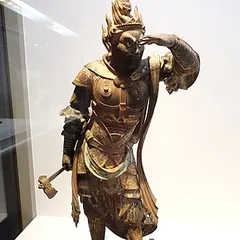
Twelve yakṣa generals promise in the sutra to protect those who keep the text. In Japan (Jūni shinshō) they are later linked to the twelve animals of the zodiac and are often shown in armour, in lively poses. The clay set at Shin-Yakushi-ji in Nara dates from the 8th century.
Go further
In the timeline: 747 · VIII · 1603
See also: The twelve generals: the army that guards the Medicine Buddha · Shin-Yakushi-ji: eleven clay generals standing guard for more than a thousand years · The story of the sūtra: Mañjuśrī, the Rescuer and the twelve generals
Where to see it: 新薬師寺 Shin-Yakushi-ji · 東京国立博物館 Tokyo National Museum · Cleveland Museum of Art
- The Seven Medicine Buddhas
七仏薬師 · 七佛藥師
Yijing’s Chinese translation of 707 describes seven buddhas in the east, of whom the Medicine Buddha is the last. In Japan they are honoured together as Shichibutsu Yakushi; at Ninna-ji, the halo of the sandalwood Yakushi carries the seven.
- The Eight Medicine Buddhas
སྨན་བླ་བདེ་གཤེགས་བརྒྱད · sman bla bde gshegs brgyad
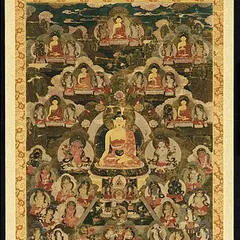
In Tibetan Buddhism, the seven buddhas of the sutra are joined by Śākyamuni, giving eight Medicine Buddhas. Paintings show them in rows or around a central figure, each with a different colour and gesture. The Freer Gallery in Washington holds such a painting.
Go further
See also: The eight Medicine Buddhas: seven brothers and a master
Where to see it: National Museum of Asian Art (Freer)
His names by country (5)
The same Buddha has a different name in each language Buddhism was passed on in. Knowing these names helps you recognise him in museums, books and temples.
- Sangye Menla (Tibetan)
སངས་རྒྱས་སྨན་བླ · Sangye Menla
Sangs rgyas sman bla, “Buddha, master of remedies”, is his Tibetan name. The Hermitage holds a thangka from Khara-Khoto (12th–13th century).
Go further
In the timeline: XII–XIII
See also: Bhaiṣajyaguru, Menla, Yaoshi, Yakushi: the names by country · Khara-Khoto: a blue Buddha from the desert, kept in Saint Petersburg · Symbols and legends: the bowl, the myrobalan, the sun, the moon and the twelve generals
Where to see it: Государственный Эрмитаж · State Hermitage Museum
Catalogue: Altar objects · Incense
- Yàoshī fó (Chinese)
藥師佛 Yàoshī fó
In China he is 藥師佛, or more fully Yàoshī Liúlíguāng Rúlái. He is often shown in a triad in a temple hall, or as the buddha of the east facing Amitābha of the west. His Pure Land is one of the great subjects of the Dunhuang murals.
Go further
In the timeline: 1319
See also: Bhaiṣajyaguru, Menla, Yaoshi, Yakushi: the names by country
Where to see it: 广胜寺 Guangsheng Temple · The Metropolitan Museum of Art
- Yakushi Nyorai (Japanese)
薬師如来 Yakushi Nyorai
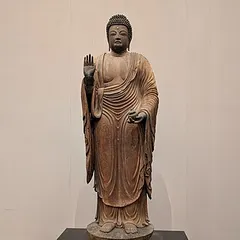
In Japan, 薬師如来 is one of the oldest buddhas honoured, from the 7th century (Hōryū-ji, Yakushi-ji). Many temples bear his name. The wooden statue shown here, from Gangō-ji, is a National Treasure entrusted to the Nara National Museum.
Go further
In the timeline: 607 · 680 · IX · IX · 1051 · 1528 · 1976 · 1989 · 1998
See also: Bhaiṣajyaguru, Menla, Yaoshi, Yakushi: the names by country · Yakushi temples in Japan: Nara, Kyoto, Mount Hiei · Yakushi-ji: the temple born of a vow to heal an empress · Hōryū-ji: the Yakushi inscription that tells of a vow made in 586
Where to see it: 奈良国立博物館 Nara National Museum · 薬師寺 Yakushi-ji
Catalogue: Altar objects · Temple goods
- Yaksa yeorae (Korean)
약사여래 Yaksa yeorae
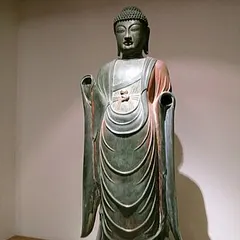
In Korea, 약사여래 became very common in the late 8th and the 9th century, under Unified Silla. The gilt-bronze standing statue from Baengnyulsa, now at the Gyeongju National Museum, is a National Treasure. Statues often hold a small medicine container.
Go further
In the timeline: VIII–IX · IX · 1962 · 1992
See also: Bhaiṣajyaguru, Menla, Yaoshi, Yakushi: the names by country · Korea: Yaksa Yeorae, a Buddha serving the kingdom of Silla
Where to see it: 국립경주박물관 Gyeongju National Museum · Los Angeles County Museum of Art
- Otoch Manla (Mongolian, Buryat)
Оточ Манла · Отошо Манла
Mongolians and Buryats call him Otoch Manla (Buryat: Otosho Manla). Manla comes from Tibetan sman bla; otoch means physician. Datsans (monasteries) in Buryatia have had temples devoted to him, such as the Manla temple of Aginsky Datsan, built in 1816.
Recognising a statue or painting (9)
- Uṣṇīṣa (cranial bump)
Uṣṇīṣa · 肉髻
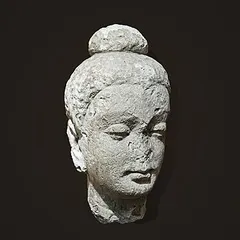
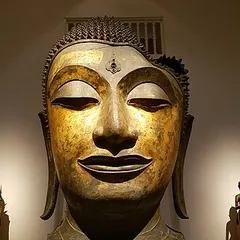
The rounded bump on top of a buddha’s head. It is one of the traditional marks of a buddha, a sign of wisdom, not a hairstyle. You will see it on almost every image of the Medicine Buddha, painted or sculpted.
- Ūrṇā (dot on the forehead)
Ūrṇā · 白毫
A small curl of hair or a dot between the eyebrows, another traditional mark of a buddha. On statues it is sometimes a set crystal or stone. It helps to tell a buddha from an ordinary figure.
Go further
- Mudrā (hand gestures)
Mudrā · 印相
The positions of the hands have codified meanings. The Medicine Buddha often has his right hand lowered, palm outward, in the gesture of giving (varada), and his left hand in his lap. In Japan the right hand is sometimes raised, in the gesture of reassurance.
- The bowl (pātra)
Pātra · 鉢 · ལྷུང་བཟེད
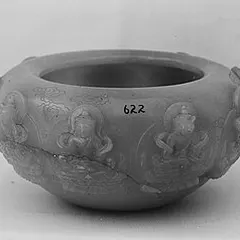
The monk’s bowl, used to receive food. In Tibetan images the Medicine Buddha holds it in his left hand, filled with medicine or nectar, often painted blue. The bowl shown here is a Qing jade bowl at the Met, an object of the same kind.
Go further
See also: The Medicine Buddha: history and iconography · Medicine Buddha objects: what are they for?
Catalogue: Statues
- Myrobalan (arura)
Harītakī · Terminalia chebula · ཨ་རུ་ར
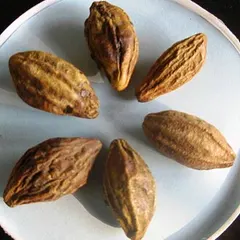
The fruit of Terminalia chebula, harītakī in Sanskrit and arura in Tibetan. It has a long history in Asian traditional pharmacopoeias. In Tibetan images the Medicine Buddha holds a stem of it in his right hand: it is his main attribute.
- The medicine jar (yakko)
薬壺 yakko · 藥壺
In Japan and Korea, the Medicine Buddha often holds a small jar or box in his left hand. It is the easiest way to recognise him there. Early statues do not have it: the main Yakushi of Yakushi-ji holds nothing.
Go further
See also: Medicine Buddha objects: what are they for?
Where to see it: Cleveland Museum of Art
Catalogue: Statues
- The lotus throne
Padmāsana · 蓮華座
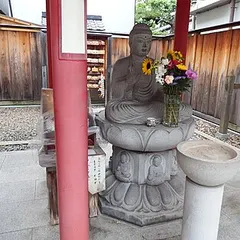
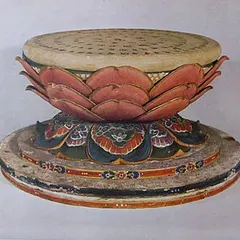
Buddhas and bodhisattvas often sit or stand on an open lotus flower. The lotus grows from mud but stays clean, an image of purity. The pedestal shown here, from Byōdō-in, illustrates the form; it belongs to another buddha.
Go further
See also: Symbols and legends: the bowl, the myrobalan, the sun, the moon and the twelve generals
Catalogue: Statues
- Halo and mandorla
Prabhāmaṇḍala · 光背 kōhai
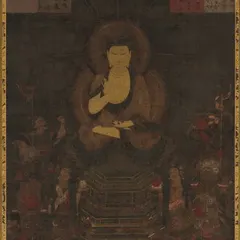
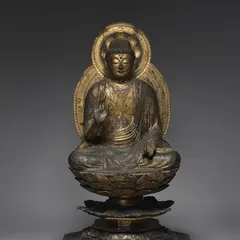
A circle of light behind the head (halo) or an almond shape around the whole body (mandorla). In Japan, the halo of a Yakushi can carry seven small buddhas, a reference to the Seven Medicine Buddhas. Here, a Yakushi from the late Heian period at the Cleveland Museum of Art.
Go further
In the timeline: 1103
See also: Symbols and legends: the bowl, the myrobalan, the sun, the moon and the twelve generals
Where to see it: 仁和寺 Ninna-ji · Cleveland Museum of Art
Catalogue: Paintings (thangkas)
- The monastic robe
Kāṣāya · 袈裟
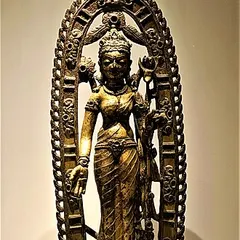
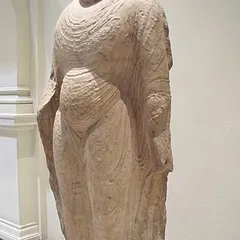
Buddhas are shown in a simple monk’s robe, with no jewels, unlike bodhisattvas, who wear crowns and ornaments. The way the folds are carved or painted helps date a work. Here, a Tang-dynasty standing Buddha at the V&A, an example of drapery.
Go further
Images and rites (3)
- Thangka
Thangka · ཐང་ཀ
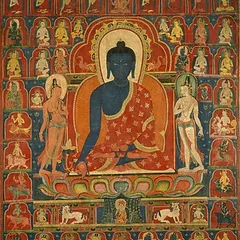
A Tibetan painting on cotton or silk, rolled for storage and mounted in brocade. Pigments are mostly mineral, bound with animal glue. The Medicine Buddha is a frequent subject; this one, from the 13th–14th century, is at the Art Institute of Chicago.
Go further
In the timeline: XII–XIII
See also: How to choose a thangka · The Medicine Buddha thangka: how the lapis-lazuli blue is painted
Where to see it: Art Institute of Chicago
Catalogue: Paintings (thangkas)
- Maṇḍala
Maṇḍala · དཀྱིལ་འཁོར
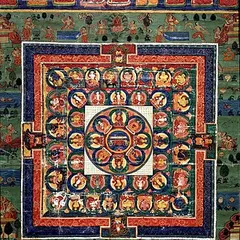
A diagram, often circular, arranging buddhas and deities around a centre. A Medicine Buddha maṇḍala gathers the Eight Medicine Buddhas, bodhisattvas and the twelve generals. It is used in rituals and meditation.
Go further
In the timeline: 2024
See also: The Medicine Buddha thangka: how the lapis-lazuli blue is painted
Where to see it: Rubin Museum of Art
Catalogue: Paintings (thangkas)
- Dhāraṇī and mantra
Dhāraṇī · 陀羅尼 · mantra
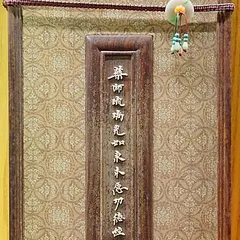
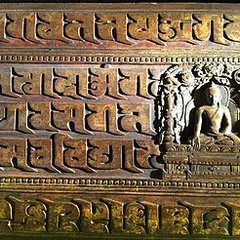
The sutra contains a dhāraṇī, a formula in Sanskrit to be recited. In Tibet a short form is widely used as the mantra of the Medicine Buddha. The image shows a woodcarving in Lantsa script, a style of writing used for such formulas.
Tibetan medicine (2)
These two words come from traditional medicine, whose tutelary figure is the Medicine Buddha.
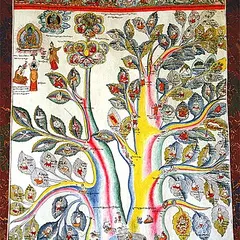
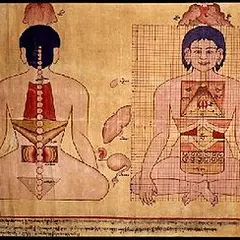
- The Blue Beryl
Vaiḍūrya sngon po · བཻ་ཌཱུར་སྔོན་པོ
Vaiḍūrya sngon po (“Blue Beryl”) is a commentary on Tibetan medicine by the regent Desi Sangye Gyatso, completed in 1688. A set of illustrative paintings was made for it between 1687 and 1703; the first shows the Medicine Buddha. Lapis presents them as historical documents.
Go further
In the timeline: 1687–1703
See also: The Blue Beryl: the regent who had medicine painted
Where to see it: Men-Tsee-Khang
- The Four Tantras
rGyud bzhi · རྒྱུད་བཞི
Rgyud bzhi, the Four Tantras, is the founding treatise of Tibetan medicine, edited in the 12th century by Yuthok Yönten Gönpo the Younger. The text is framed as a teaching given by the Medicine Buddha. Lapis presents it as a historical text.
Go further
In the timeline: XII · 1696 · 1725 · 1916
See also: The Four Tantras: when the Medicine Buddha teaches in the city of Tanaduk · Chakpori and Men-Tsee-Khang: three centuries of Tibetan medical colleges
Where to see it: Men-Tsee-Khang · 塔尔寺 Kumbum Monastery
Treasures and canons (2)
- Hibutsu (hidden buddha)
秘仏 hibutsu
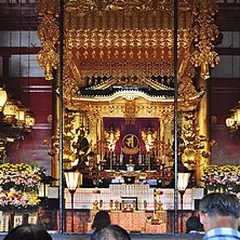
In Japan, some statues are kept in a closed cabinet (zushi) and shown only rarely, sometimes once every few decades. The main Yakushi of Daigo-ji is such a hidden buddha. The photo shows the altar of Sensō-ji in Tokyo, whose main image is also hidden.
Go further
In the timeline: 907
See also: Yakushi temples in Japan: Nara, Kyoto, Mount Hiei
Where to see it: 醍醐寺 Daigo-ji
- Kangyur and Taishō (the canons)
Kangyur · བཀའ་འགྱུར · Taishō 大正藏
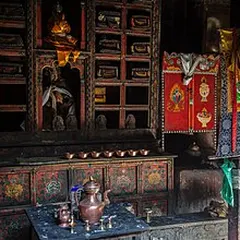
The large collections of Buddhist scriptures. In the Tibetan Kangyur the sutra is number 504 in the Tohoku catalogue (Toh 504); in the Chinese Taishō canon, volume 14 holds its translations (nos. 449–451). Both can be read freely online.
Go further
In the timeline: IV · IX · 1924–1934
See also: The Medicine Buddha Sūtra: the story of a travelling text
Where to see it: National Archives of India
Sources (23)
- Wikipedia, Bhaisajyaguru
- Wikipedia, Lapis lazuli
- Wikipedia, Tathāgata
- Xuanzang 玄奘 (650), Taishō T14 n0450
- 84000, The Detailed Account of the Previous Aspirations of the Blessed Bhaiṣajyaguruvaiḍūryaprabha (Toh 504)
- Wikipedia, Yakushi-ji
- Wikipedia, Twelve Heavenly Generals
- Yijing 義淨 (707), Taishō T14 n0451
- Wikipedia, 경주 백률사 금동약사여래입상
- Wikipedia, Бхайшаджьягуру
- Wikipedia, Ushnisha
- Wikipedia, Urna
- Wikipedia, Mudra
- Wikipedia, Alms bowl
- Wikipedia, Terminalia chebula
- Wikipedia, Lotus throne
- Wikipedia, Halo (religious iconography)
- Wikipedia, Kasaya (clothing)
- Wikipedia, Thangka
- Wikipedia, Mandala
- Wikipedia, Traditional Tibetan medicine
- Wikipedia, Hibutsu
- Wikipedia, Kangyur
Texts by Lapis, checked on 17 October 2026. Historical and cultural content.