Lapis lazuli, the colour of the Medicine Buddha
A stone mined in the mountains of Afghanistan, worn by pharaohs, ground by Renaissance painters, and chosen to describe the light of a Buddha.
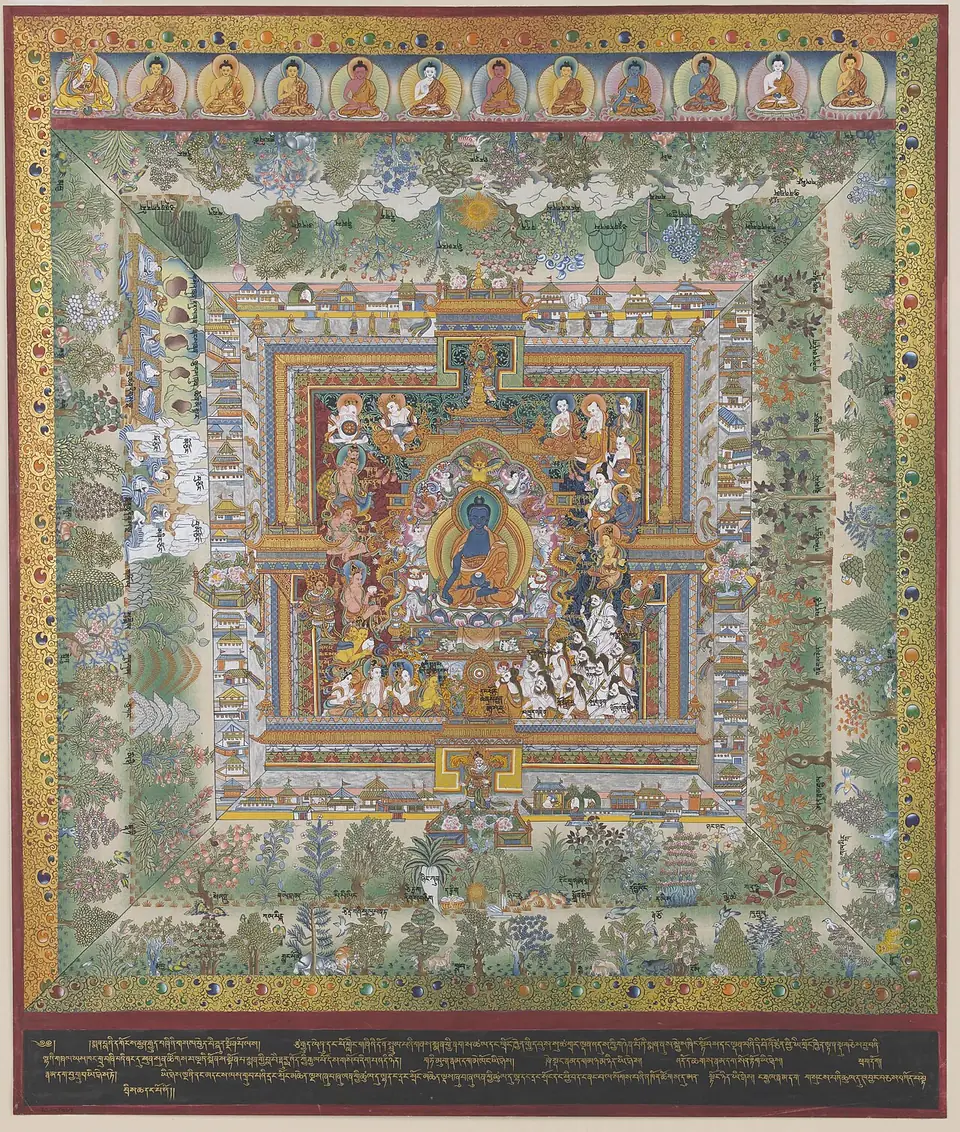
Why is the Medicine Buddha blue? The answer is in the title of the sūtra itself: his light is that of vaiḍūrya, a translucent blue stone. Tradition links it to lapis lazuli, and this link became the most famous image of this Buddha. Follow this blue thread with us, from the stone to the paintings.
A stone from the end of the world
The oldest known mines are at Sar-e-Sang, in the Badakhshan mountains of Afghanistan, and they have been worked for more than six thousand years. From these remote valleys the stone travelled to Mesopotamia, to Egypt (Tutankhamun’s mask has lapis inlaid in its eyebrows and eye outlines) and, along the Silk Road, to China. For European painters it was “ultramarine”, from beyond the sea: it was ground to produce a blue so costly that it was kept for the Virgin’s mantle. The blue of the turban in Vermeer’s Girl with a Pearl Earring is a famous example.
What does it look like?
Its colour comes from lazurite. Its blue night is scattered with small golden flecks of pyrite and white veins of calcite. Many saw a starry sky in it, an image naturally linked to the Buddha’s light, which “shines like lapis lazuli” in his body and his world.
Lapis or vaiḍūrya?
The correspondence is not so simple. The Sanskrit vaiḍūrya was rendered in Chinese as liuli, which came to mean coloured glass, and scholars hesitate between beryl, cat’s eye and lapis. In Tibet the deep blue of the stone fixed the image: Desi Sangye Gyatso’s great medical commentary, at the end of the 17th century, is called the “Blue Beryl” (Vaiḍūrya sngon po), a direct homage to Sangye Menla.
From mineral blue to synthetic blue
In thangka painting, azurite or indigo, less rare, are more common; lapis was kept for costly works. Artificial ultramarine only appeared in the 19th century: in France, Jean-Baptiste Guimet was one of those who developed a manufacturing process around 1826–1828, after a competition with a prize offered by the Société d’encouragement.
At home
Today lapis lazuli goes into malas, beads and jewellery. To own it, prefer beads whose seller states the origin, and beware of imitations (dyed glass, coloured howlite): irregular golden flecks of pyrite are a clue, not a proof; ask about the origin. Lapis malas are a gift often chosen to accompany practice, and the thangkas show the Buddha’s blue.
Sources
- Medicine Buddha Sūtra (Chinese translations, Taishō 449–451) — T449 · T450 · T451
- Raoul Birnbaum, The Healing Buddha (1979)
- Mauritshuis, analyses of the Girl with a Pearl Earring
The exact identity of vaiḍūrya remains debated.
In the catalogue : Prayer beads (malas) and jewellery
Lapis is free and has no advertising. You can support its upkeep.