Sunlight and Moonlight: the two bodhisattvas beside the Medicine Buddha
Sūryaprabha and Candraprabha, called Nikkō and Gakkō in Japan: who they are in the sūtra, how to recognise them, and where to see the famous triad of Yakushi-ji.
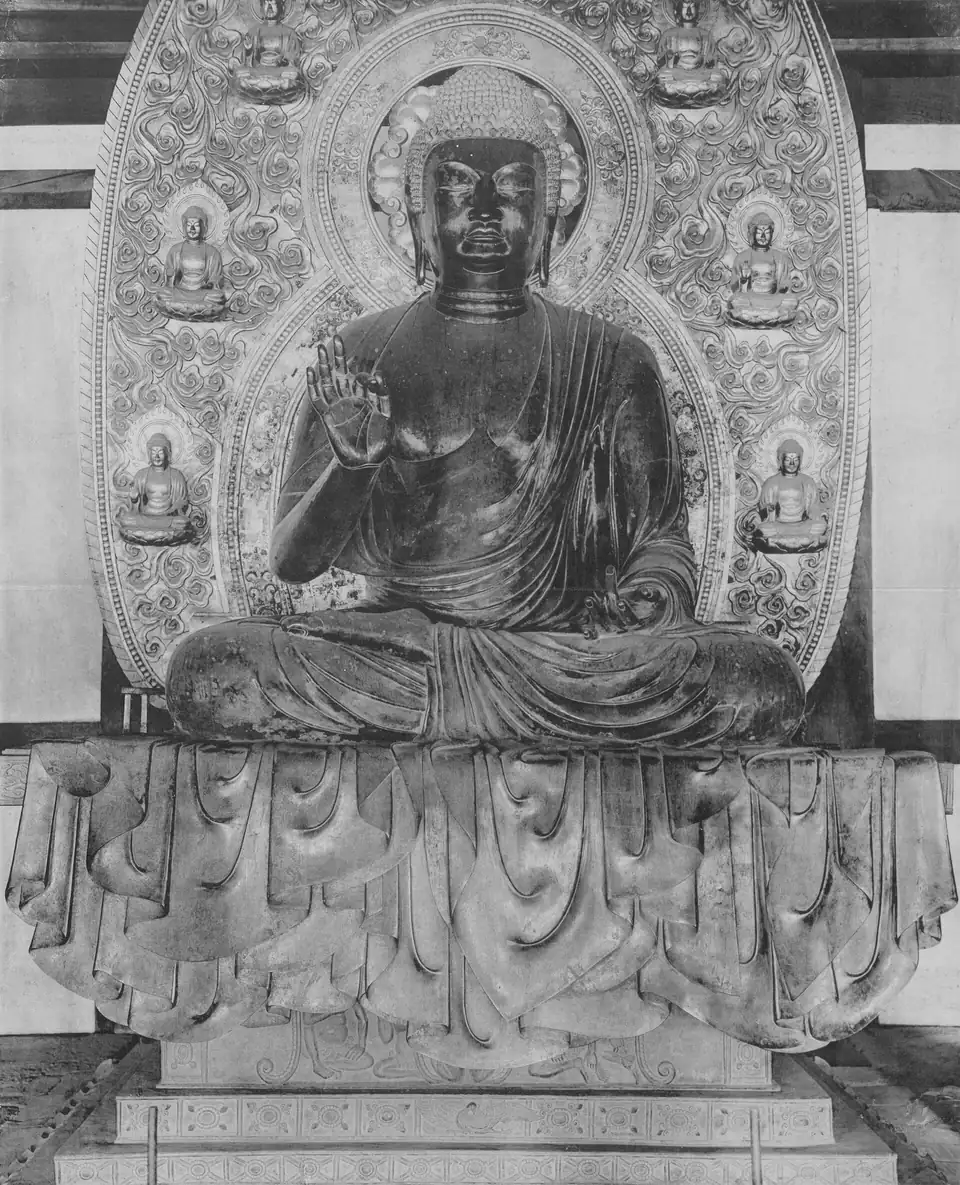
In many temples, the Medicine Buddha is not alone. Two standing bodhisattvas frame him: one carries the sign of the sun, the other the sign of the moon. Together they form the "Medicine Buddha triad". Here is what the texts say about them, and how artists show them.
What the sūtra says
In the Medicine Buddha Sūtra, the Buddha describes the pure land of the East, the land of lapis lazuli light. In that land live two great bodhisattvas, "Sun Illuminating All" and "Moon Illuminating All" (in Sanskrit Sūryaprabha and Candraprabha; in Chinese 日光遍照 and 月光遍照). The sūtra presents them as the first among countless bodhisattvas, and as the keepers of the Medicine Buddha's teaching.
Their names across Asia
- Sanskrit: Sūryaprabha ("sunlight") and Candraprabha ("moonlight").
- Chinese: Riguang Pusa and Yueguang Pusa (日光菩薩, 月光菩薩).
- Japanese: Nikkō Bosatsu and Gakkō (or Gekkō) Bosatsu.
- Korean: Ilgwang Bosal and Wolgwang Bosal.
How to recognise them
The two figures are made as a pair, in mirror image. If one raises the right arm and lowers the left, the other raises the left arm and lowers the right. Their crowns, or the objects they hold, often carry a sun disc and a moon disc. In the Japanese mandala of the Womb Realm, Moonlight holds a lotus bearing a half moon.
Behind or around the triad, you often find the twelve generals, the guardians who protect those who recite the sūtra; see The twelve generals.
The triad of Yakushi-ji, in Nara
The best-known example is the bronze triad of the Golden Hall (Kondō) of Yakushi-ji, in Nara. The two attendants, standing, are listed as National Treasures of Japan. Scholars still debate whether the group was cast for the first Yakushi-ji, at Fujiwara-kyō, or in the early Nara period, after the temple moved. Read Yakushi-ji: the temple born of a vow and Yakushi temples in Japan.
Elsewhere
- China: a Northern Wei stele of about 500 CE, now at the Metropolitan Museum of Art, shows the Medicine Buddha standing between his two attendants.
- Han Chinese Buddhism: the birthday of Moonlight is often kept on the 15th day of the 8th lunar month, the day of the Mid-Autumn festival.
- Tibet: the two are less often painted; Tibetan thangkas put the Eight Medicine Buddhas first; see The eight Medicine Buddhas.
Light, not magic
In the Buddhist reading, the sun and the moon stand for a light that works day and night: the light that dispels ignorance, seen as the root of suffering. It is an image of the mind.
Sources
- 84000, translation of the sūtra of the Medicine Buddha's previous aspirations (Toh 504)
- Wikipedia, "Sūryaprabha"
- Wikipedia, "Candraprabha"
- Wikipedia (Japanese), "Nikkō Bosatsu"
- Wikipedia (Japanese), "Gakkō Bosatsu"
- Wikipedia, "Bhaisajyaguru" (Northern Wei stele)
- Wikipedia, "Yakushi-ji"
Lapis is free and has no advertising. You can support its upkeep.