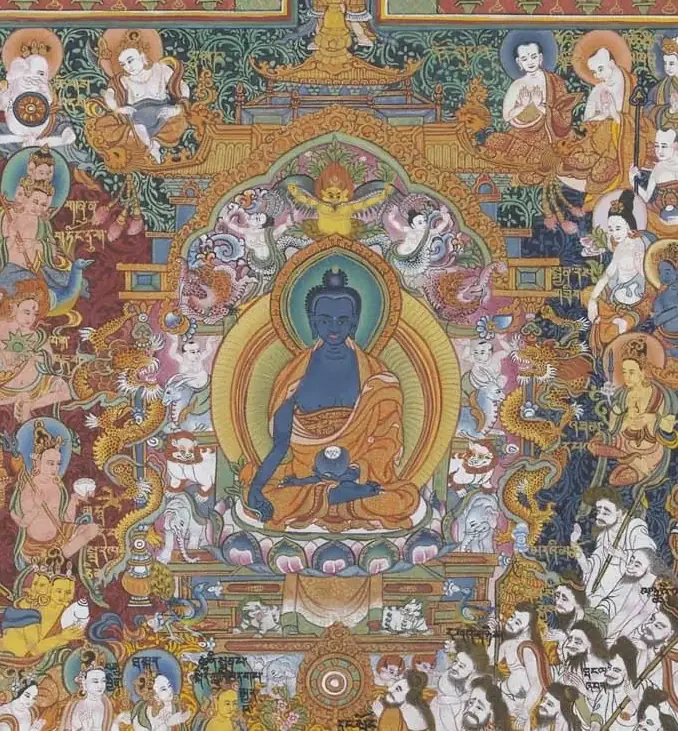
Colours, materials and styles of Medicine Buddha images
Pigments, metals, wood, cloth and stone: what images of the Medicine Buddha are made of, and how styles differ from Tibet to Japan and from Java to Vietnam, down to today’s popular versions.
Materials
Lapis lazuli and ultramarine
A blue stone mined for millennia in Badakhshan (Afghanistan). Ground and purified, it gives ultramarine, a costly blue used for the body of the Medicine Buddha in the finest paintings.
Azurite
A copper mineral, cheaper than lapis, that gives a deep blue. It is the most common blue of thangkas and Dunhuang murals; it can darken over the centuries.
Malachite
A green copper mineral, often found with azurite. It gives the greens of landscapes, leaves and robes in Tibetan and Chinese painting.
Cinnabar and vermilion
A red mercury ore, or its synthetic equivalent. It gives the bright reds of robes and borders. It is toxic to handle, so painters work it with care.
Orpiment and ochres
Orpiment, an arsenic mineral, gives a bright yellow; ochres, earths, give yellows and browns. Both appear in halos, flames and skins.
Gold
Gold is used as leaf, laid on statues (gilding), or ground as paint for the lines of thangkas. On Tibetan and Nepalese bronzes it is applied by fire-gilding.
Ink and drawing
Before colour, the figure is drawn in charcoal then ink, following grids of proportion. In Japan and China, ink is also used alone for prints and sutra copies.
Cotton, silk and paper
Thangkas are painted on cotton prepared with gesso, sometimes on silk. Chinese and Japanese paintings use silk or paper, then are mounted as hanging scrolls.
Bronze and lost-wax casting
Many statues are cast in bronze by the lost-wax method: a wax model is covered in clay, the wax is melted out and replaced by metal. The Yakushi-ji triad and Tibetan bronzes are made this way.
Wood
In Japan most statues are in wood: carved from a single block (ichiboku-zukuri) in the early Heian period, then assembled from several blocks (yosegi-zukuri). Woods include cypress (hinoki), katsura and sandalwood.
Dry lacquer
A technique of the Nara period: layers of hemp cloth soaked in lacquer are built up over a core, then refined. Light and precise, it gives very fine faces.
Clay and murals
Clay statues and paintings on plaster: the Dunhuang caves are covered with them, and the Twelve Generals of Shin-Yakushi-ji are in clay. These are fragile materials, sensitive to humidity.
Stone
Stone is used for statues in the open air, especially in Korea: the granite Gatbawi on Mount Palgong is an example. Carved in the rock or assembled from blocks.
Textiles and appliqué
Some thangkas are not painted but sewn from pieces of silk (appliqué) or embroidered. Very large ones are unrolled on hillsides for festivals.
Styles compared
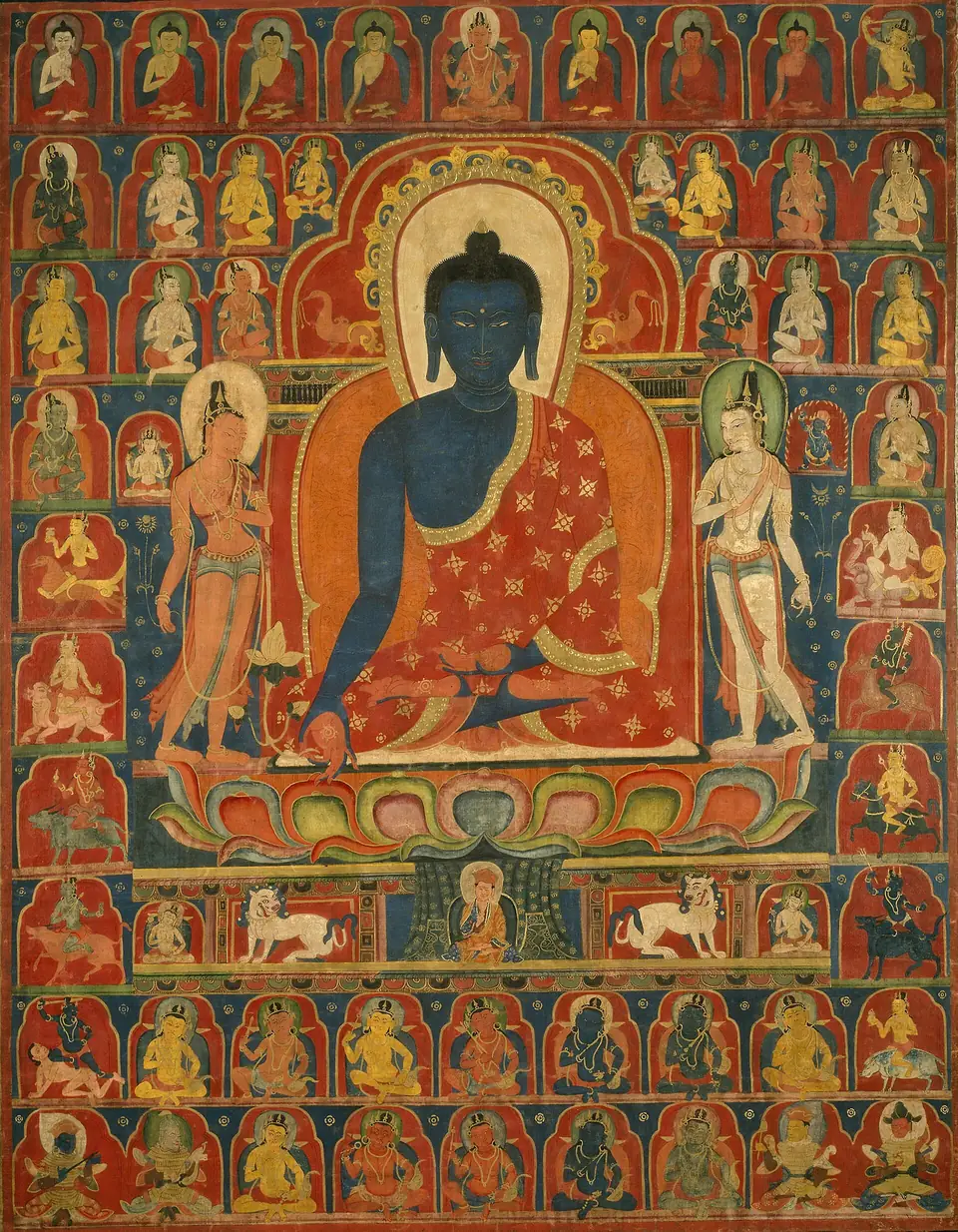
Tibet and the Himalaya
A deep blue body, often surrounded by the Eight Medicine Buddhas. Painting follows strict proportion grids; schools such as Menri and Karma Gardri differ in colours and landscapes.
Tibetan thangka · 1201–1400 · Art Institute of Chicago
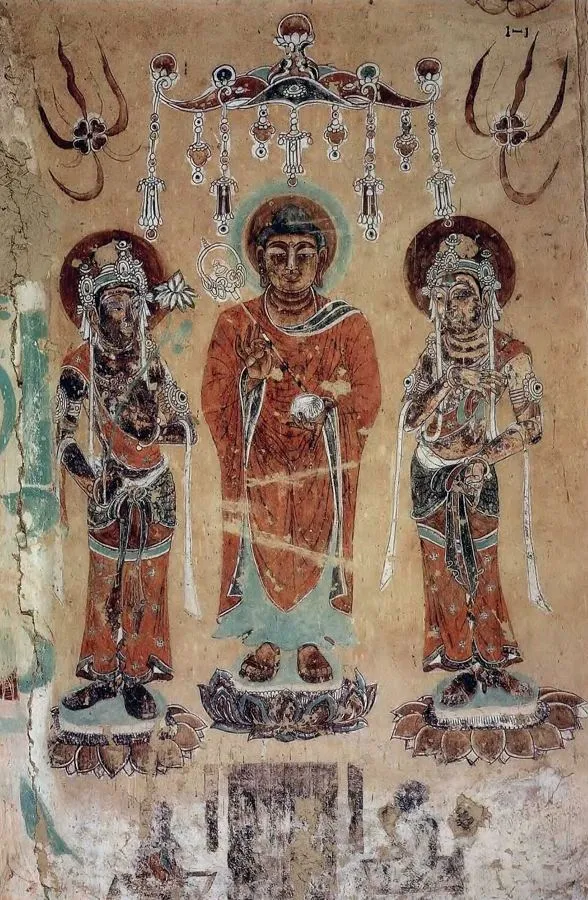
China, Tang dynasty
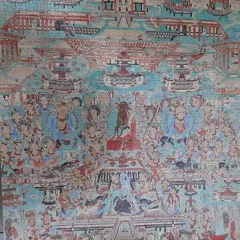
At Dunhuang, the Medicine Buddha appears in vast paradise scenes, with palaces, lakes and orchestras. The forms are full, the colours mineral, and the faces calm.
Chinese mural · 618–649 · Mogao Cave 322, Dunhuang
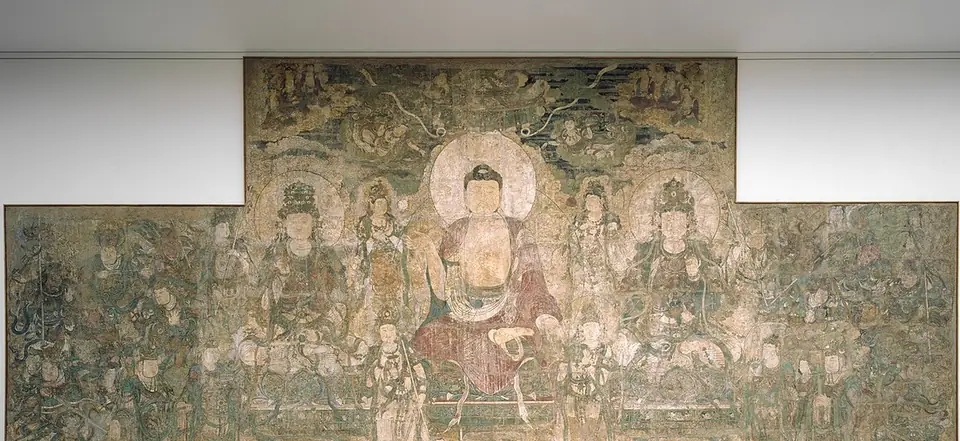
China, Yuan and Ming
Temple murals grow monumental, as at Guangsheng Temple (about 1319, now at the Met). Draperies flow, the colours are warmer, and the attendants are richly dressed.
Chinese mural · ~1319 · The Metropolitan Museum of Art
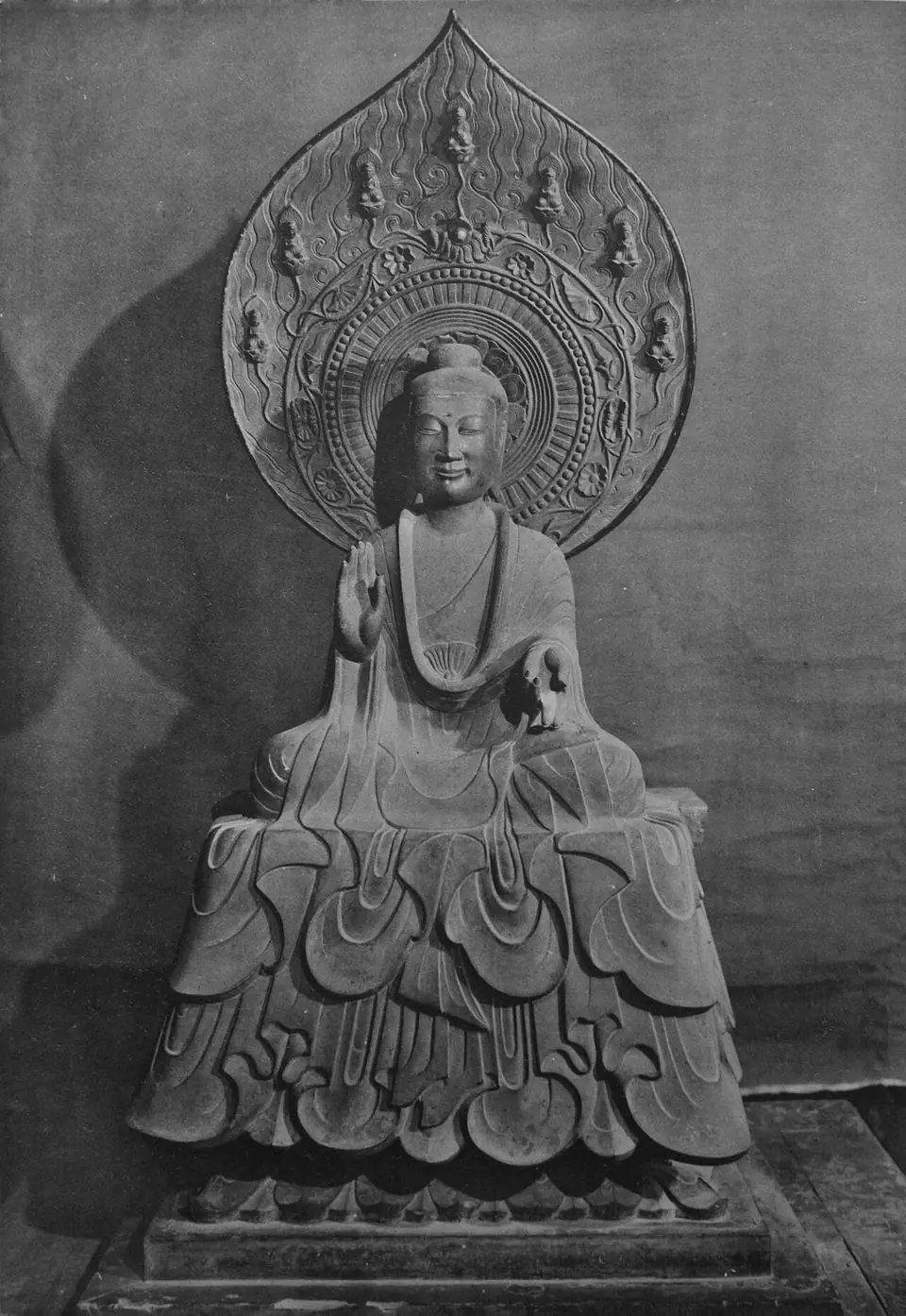
Japan, Asuka and Nara
The first great statues are in gilt bronze or dry lacquer, solemn and frontal, as at Hōryū-ji and Yakushi-ji. The hands are empty: the medicine jar comes later.
Japanese statue · 607 · Hōryū-ji · Tōkyō Bijutsu Gakkō
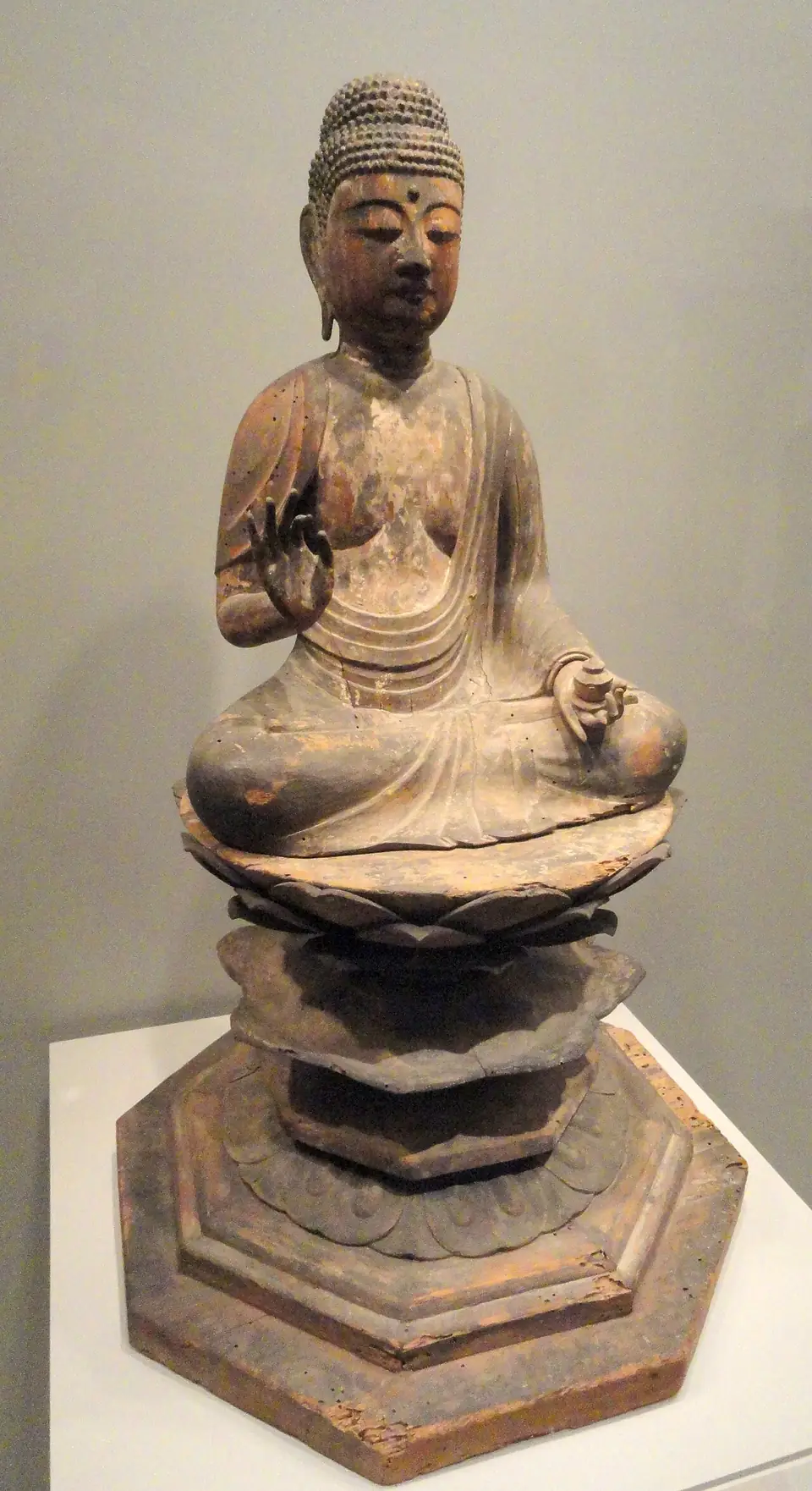
Japan, Heian and after
Wood dominates: heavy, imposing figures first, then gentler ones from the 11th century. The Yakushi holds a jar, with Sunlight, Moonlight and the Twelve Generals.
Japanese statue · 900–1100 · Art Institute of Chicago · Daderot
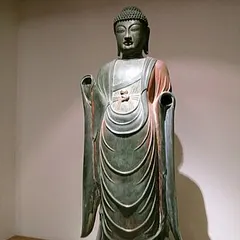
Korea, Unified Silla
Gilt-bronze and stone statues of the 8th–9th century, slender or strong, often holding a medicine container. Gatbawi and Baengnyulsa are well-known examples.
danielcraig (Standing Gilt-bronze Bhaisajyaguru Buddha of Baengnyulsa Temple(백률사 금동약사여래입상)) · CC BY-SA 2.0
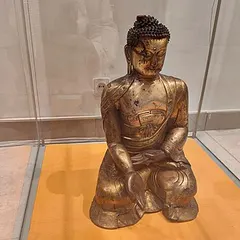
Mongolia and Buryatia
Gilt bronzes and thangkas in the Tibetan tradition, with local workshops. The school of Zanabazar (17th century) is known for its elegant bronzes.
Александр Сигачёв (Museum of the Middle Urals - Buddha Bhaishajyaguru) · CC0
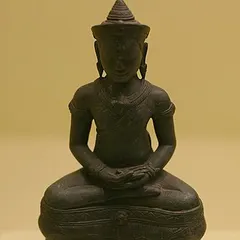
Cambodia (Khmer art)
Under Jayavarman VII, at the end of the 12th century, the inscriptions of the hospital chapels of Angkor invoke Bhaiṣajyaguru. Khmer bronzes of this period are attributed to him, such as the one in the Brooklyn Museum (around the 12th century). They show the Angkor style: a calm face, a slight smile, simple and compact forms.
shooting_brooklyn · Brooklyn Museum (WLA brooklynmuseum Bhaisajyaguru Buddha of Healing) · CC BY-SA 2.5
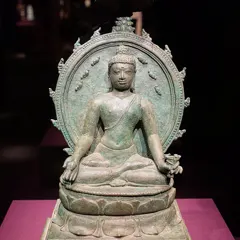
Indonesia (Central Java)
Small high-tin bronze statuettes, dated to the 8th–9th centuries, come from Central Java, in the time of Borobudur. Several are kept at the Smithsonian in Washington. Their identification as the Medicine Buddha rests mainly on the object held in the hand; museums often present it with caution.
Daderot (Medicine buddha Bhaishajyaguru, Indonesia, central Java, 700s-800s AD, high tin bronze - Arthur M. Sackler Gallery - DSC05112) · Public domain
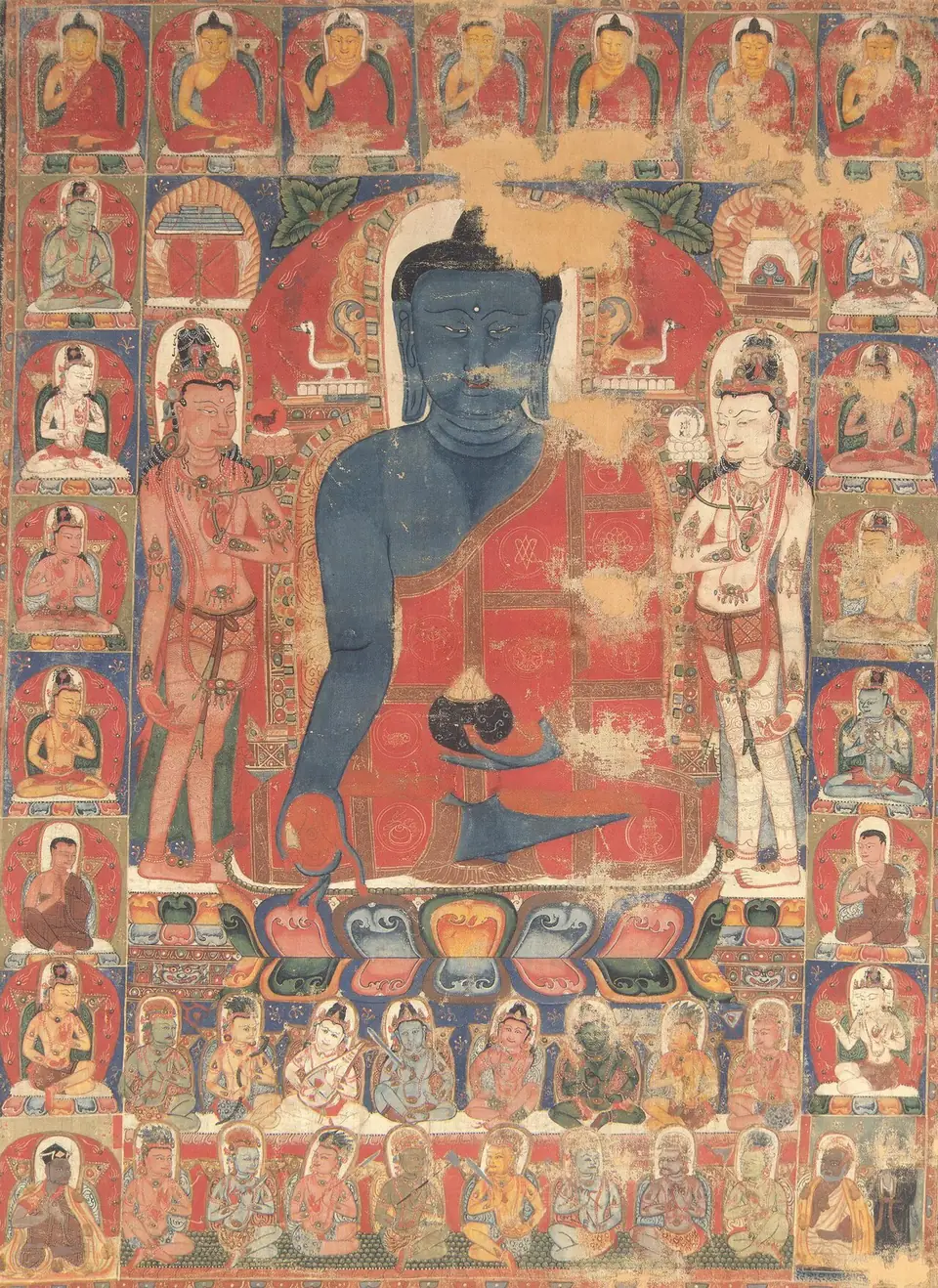
Tangut kingdom (Khara-Khoto)
At Khara-Khoto, a city of the Tangut Western Xia kingdom, Pyotr Kozlov’s Russian expedition found, in 1908–1909, paintings on cotton from the late 12th and 13th centuries. Now in the Hermitage, they mix the Tibetan manner (composition, colours) with Chinese details (faces, clothing).
Central Asian painting · 1201–1300 · State Hermitage Museum
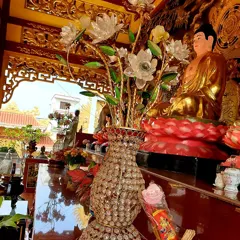
Vietnam (modern era)
In Vietnam he is called Phật Dược Sư. Many Mahayana pagodas give him an altar or a hall, such as the Dược Sư Phật Điện of Bảo Thắng pagoda in Thủ Đức (photo from 2021). Recent statues there are often gilded and painted in bright colours.
Phương Huy (Chùa Bảo Thắng ở Thủ Đức, tháng 12 năm 2021 (tượng Phật ở Dược Sư Phật Điện) (1)) · CC BY-SA 4.0
Modern and popular versions
The old images also live on in popular forms: posters, prints, resin figurines, and even a 1000-piece jigsaw puzzle (2021) reproducing the Medicine Buddha wall painting of Mogao Cave 12. These objects are not old works, but they show how these images travel today.
See also: Vaiḍūrya (lapis lazuli) · Thangka · Halo and mandorla · The monastic robe · The lotus throne · Mudrā (hand gestures)
Sources (22)
- Wikipedia, Lapis lazuli
- Wikipedia, Azurite
- Wikipedia, Malachite
- Wikipedia, Vermilion
- Wikipedia, Orpiment
- Wikipedia, Gilding
- Wikipedia, Thangka
- Wikipedia, Lost-wax casting
- Wikipedia, Japanese Buddhist sculpture
- Wikipedia, Lacquerware
- Wikipedia, Mogao Caves
- Wikipedia, Gatbawi
- Wikipedia, Appliqué
- The Met, 65.29.2
- Wikipedia, Hōryū-ji
- Wikipedia, 경주 백률사 금동약사여래입상
- Wikipedia, Zanabazar
- Wikimedia Commons, Brooklyn Museum 71.166 (Khmer art)
- Wikimedia Commons, Arthur M. Sackler Gallery, Central Java, 700s–800s
- Wikimedia Commons, Hermitage, hall 363 (Khara-Khoto)
- Wikimedia Commons, Chùa Bảo Thắng, Thủ Đức (2021)
- Wikimedia Commons, 1000-piece puzzle, Mogao Cave 12 (2021)
Texts by Lapis, checked on 17 October 2026. Historical and cultural content.