How to choose a mala: bead count, materials, lapis lazuli
108 beads or a wrist mala, wood, seeds or stone, counters, real lapis or imitation: a sourced guide to choosing a mala.
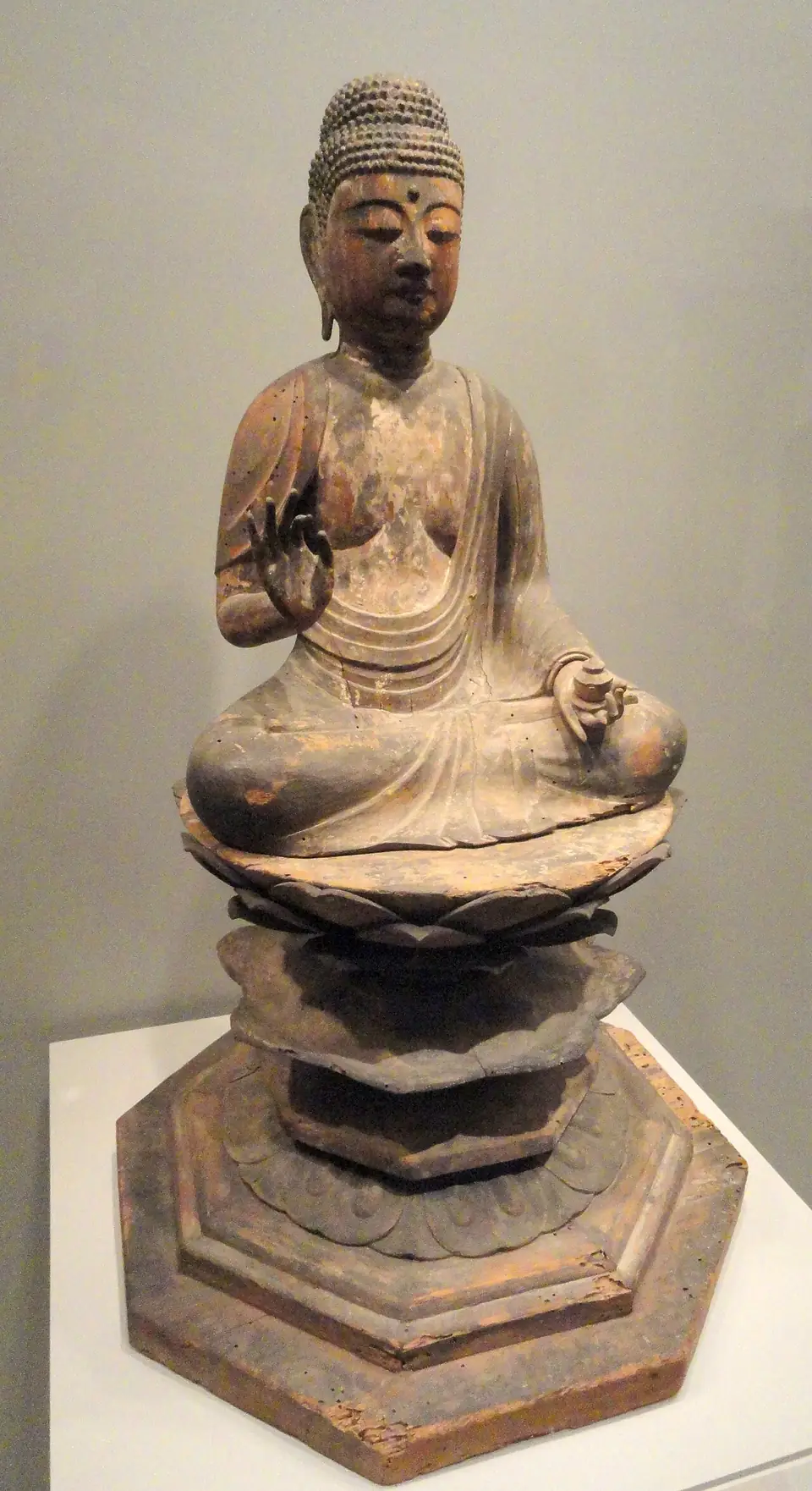
A mala (Sanskrit mālā, "garland") is a string of beads used to count the recitations of a mantra, such as the Medicine Buddha mantra. Here is what helps before choosing one.
108 beads, or fewer
The classic Buddhist mala has 108 beads plus a larger "guru" or mother bead, which is not counted. Shorter versions exist, often 54, 27 or 21 beads, worn on the wrist. For counting a mantra, 108 beads is the most practical; a wrist mala is handy to keep one with you.
An ancient origin
The oldest known text describing this use is the Soapberry Seed Sutra (Mu huanzi jing, Chinese canon, Taishō no. 786). In it the Buddha tells a king to string 108 soapberry seeds and recite the names of the Buddha, Dharma and Sangha while passing them through his fingers.
Wood, seeds or stone
- Wood: sandalwood and other fragrant woods, light and pleasant in the hand.
- Seeds: so-called "bodhi" beads actually come from several plants (jujube, "moon and stars" rattan…), not from the Bodhi tree.
- Stones: agate, rock crystal, lapis lazuli. According to several Tibetan teachers, these are the most highly regarded.
About lapis lazuli
Lapis lazuli is tied to the Medicine Buddha, whose sutra describes his body as lapis lazuli. It is a rock, made mostly of lazurite (the blue), calcite (the white) and pyrite (the golden flecks). The most prized blue is deep and even, with little visible calcite. Treatments (dye, wax) and imitations exist: ask the seller whether the stone is natural and whether it has been treated.
Choosing in practice
- Bead size: 6–8 mm for a wrist mala, 8–10 mm for a 108-bead mala held in the hand.
- Cord: a knot between beads limits breakage and wear.
- Counters: Tibetan malas sometimes carry two short cords of ten beads to count rounds.
- Tradition: in Japan the shape of the juzu differs by school (Shingon, Tendai, Jōdo…). If in doubt, ask your temple or teacher.
Respect and care
By a widespread custom, a mala is not put on the floor; it is kept in a pouch or on the altar. A mala is a tool for counting and recollection.
To recite, see the mantra and its meaning; to buy, the malas section of the catalogue.
Sources
- Soapberry Seed Sutra (Taishō no. 786), text on Wikisource
- Wikipedia article "Buddhist prayer beads"
- Gemological Institute of America, lapis lazuli page
- Li et al. (2014), "Seeds used for Bodhi beads in China", Journal of Ethnobiology and Ethnomedicine
In the catalogue : Prayer beads (malas) and jewellery
Lapis is free and has no advertising. You can support its upkeep.