Zanabazar and his school: the Medicine Buddha in Mongolian bronze
Monk, sculptor and inventor of a script, Zanabazar gave Mongolia a recognisable bronze style, in which Otoch Manla has his place.
Zanabazar (1635–1723) was the first Jebtsundamba Khutuktu, head of Buddhism among the Khalkha Mongols. The Fine Arts Museum that bears his name in Ulaanbaatar recalls that he was also a sculptor, linguist and educator.
A life between the steppe and Tibet
Enthroned as a child in 1639, he travelled to Tibet around 1650 to meet the Fifth Dalai Lama and the Panchen Lama. Back home he founded workshops and monasteries; in 1686 he created the Soyombo script.
A bronze style
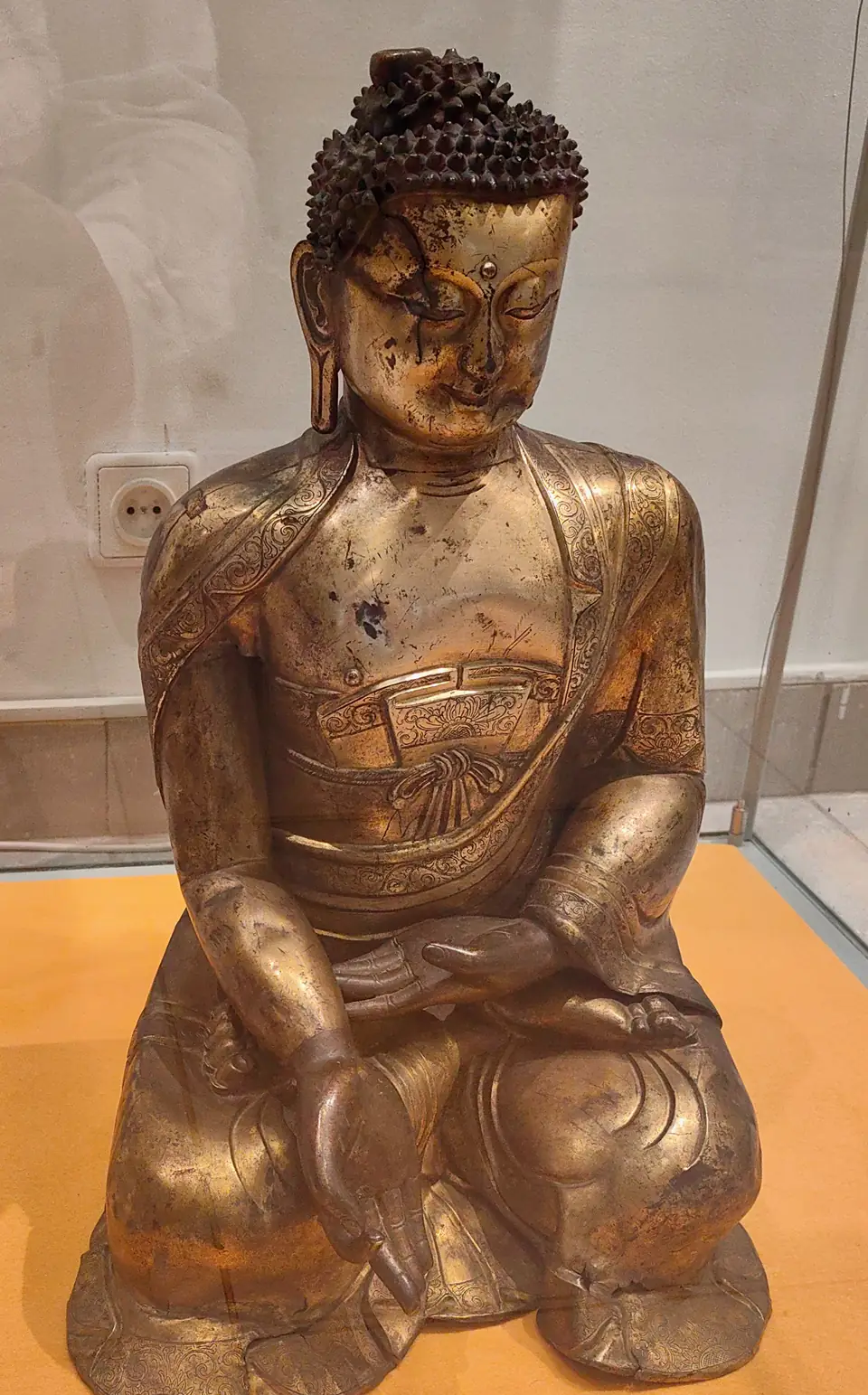
Gilt bronzes attributed to Zanabazar or his school are known by their broad shoulders, slim waists, calm faces and high double-lotus bases. Mongolian workshops, and later those of Dolonnor in Inner Mongolia in the 18th and 19th centuries, carried these models on.
Otoch Manla in this style
The Medicine Buddha keeps his usual iconography (see Symbols and legends). The picture on this page shows a gilt-bronze Bhaiṣajyaguru from Dolonnor (18th–19th century). See also the Mongolia and Buryatia page.
Uncertainties
Few works are by Zanabazar’s own hand; scholars cautiously speak of a “style” or “school”. Workshop dates are often approximate.
Sources
- Fine Arts Zanabazar Museum, en.zanabazarmuseum.mn
- Wikipedia, Zanabazar
- N. Tsultem, Mongolian Sculpture, 1989
- Wikimedia Commons, Bhaishajyaguru, Dolonnor (Museum Middle Urals)
Lapis is free and has no advertising. You can support its upkeep.